Tip on a cruise
Whether it’s your first cruise or your 50th, there are always new cruise tips to learn as you take your trip. We’ve put together 107 amazing cruise tips, secrets, and freebies for you to enjoy.
107 Cruise Tips, Secrets, Tricks, and Tricks Header

This list varies from relatively small tips to make your cruise a little more comfortable to the big secrets that cruise lines don’t like to talk about. And while experienced cruisers may know some of the things on this list, you can be sure that everyone reading will learn at least a few helpful tips.
To make things easier, we’ve divided our 107 tips into separate sections, including saving money, packing, staying healthy, and more.
Note: This article contains links to Amazon which are affiliate links. If you make a purchase, we receive a small percentage of the sale at no additional charge to you.
- In this article…
- Our 10 Best Cruise Tips
- Money-saving tips for your cruise
- Packing Tips for Your Cruise
- Dining Tips for Your Cruise
- Safety and health tips for your cruise
- General tips and things to know for your cruise
- Our 10 Best Cruise Tips
- Cruise ships are parked close to each other.
If you want the best of the best, these tips are our favorites. But don’t miss a dozen more things to know about us below.
Many hotels near the port will offer free (or discounted) cruise parking and/or shuttles to the ship
Do you plan to drive for your cruise and need a place to stay? Look for hotels that offer cruise parking. Hotels in port cities will do what they can to attract cruise passengers. This means they will let you park at their hotel for free (or at a huge discount) during your cruise. Many will also offer shuttle rides to the cruise port.
There’s no better way to save money on your cruise parking and port than with this tip. See our list of hotels in each port with cruise shuttles, including Miami hotels with cruise port shuttles.
Traveling on older ships is cheaper.
If you’re someone who likes a deal, consider traveling on an older ship. Even if an old ship and a new ship operate the same itinerary, the old ship’s fares will be dramatically lower.
Of course, you won’t get wild new things like water slides and ten swimming pools in return. But if you’re someone who just wants to get out on the water, you can save hundreds of dollars by sailing on an older ship.
Bring your own power adapter to give you more outlets.
Phones, iPads, laptops, curling irons… the list of things you’ll bring that need to be plugged in grows by the year. However, many cruise ship cabins have limited outlets. The good news is that newer ships are being built with more power outlets. Still, we recommend bringing an adapter or two to increase the number of available plugs.
We really like this one from Amazon, which offers three plugs and doesn’t take up much space. Also, make sure your plug doesn’t have a surge protector. They are not allowed on board.
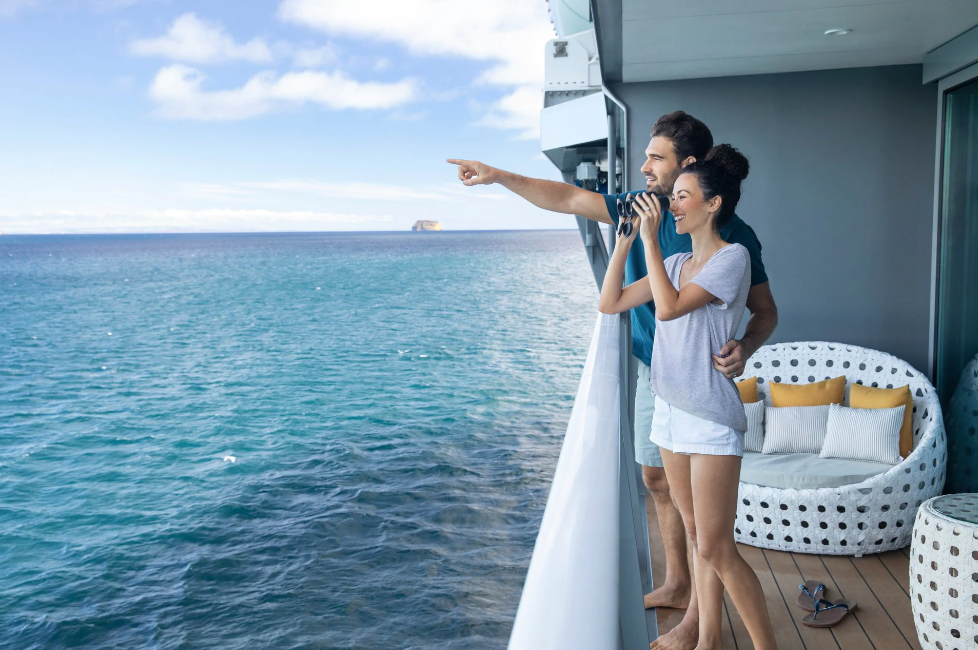
Your balcony isn’t as private as you think.
Railings of ships
Thinking of sunbathing “alfresco” on your balcony? Want to take a little risk with your partner in the fresh air? Keep in mind that your balcony is not that private. There are low dividers between the balconies to allow air to pass through. They are also several inches above the floor to drain water. This means that anyone on the balcony next to you can easily see what’s going on without any effort.
Those “all you can drink” packages aren’t a good deal, unless…
“All you can drink” alcohol packages can really help your budget. For a fixed amount, you can drink as much as you want without worrying about the bill. But buyer beware, the price of the packages usually means you’ll need to order 7-10 drinks per day before you’ll save money.
And since you have to buy a package for each day of your cruise, that means you’ll have to drink coffee every single day on your ship – even when you’re in a port of call.
Many will find that they are better than just ordering drinks the old-fashioned way. (Read more about all drink packages here or use our drink package calculator to see if you can save money.)
Turn your phone on airplane mode as soon as you board the plane.
There are many horror stories of cruise passengers forgetting to turn off their phone data and then coming home to hefty bills for international roaming.
So you should either turn off your phone completely or turn it on airplane mode where it doesn’t use data (but can still connect to Wi-Fi). It’s the easiest way to make sure there aren’t any big surprises when you get your next phone bill.
If traveling on less than three decks, take the stairs. It is very fast.
Who climbs the stairs on vacation?
Art auctions have free wine.
If you want to snag a cheap glass of champagne, head to the onboard art auctions. This auction offers a flute of bubbly to set the mood and entice you to spend some dough. While art costs money, wine is free.
You will pay for premium brands, but not generics.
If you want that special gelato or Starbucks coffee, it’s likely to cost you a few bucks on board. What many people don’t realize, however, is that you can get generic versions of these meals for free on board (and sometimes on the spot).
For example, if your ship sells Starbucks for a fee, just ask if they have any free coffee. If they are not at that location, they will point you to where you can get it at no charge.
Cheaper interior cabins mean more money for more cruises
Interior cabin
Many claims that they could not travel in anything other than a balcony room. But interior cabins can run you hundreds or even thousands on board—less than what you’d pay for a balcony room. Considering that many people are rarely in their cabins other than to sleep, it doesn’t make sense to pay a fortune for a room you won’t use. Instead, you can travel much cheaper with an interior room… and possibly cruise a lot!
Don’t waste money on substandard internet.
Being connected is just a fact of life these days. Not surprisingly, many choose to pay for the cruise line‘s Wi-Fi service, even though it’s expensive. If you decide to purchase, you’ll find that there are tiers of service. So you can pay less and get slower or limited service, or pay a little more to get faster speeds and full access to the web.
In this case, you should not waste your money on the cheapest service. Even at its best, the Wi-Fi on a cruise ship will be slower than what you’re used to seeing at home. In our experience, the lower levels are almost unusable. This is one place you don’t want to skimp on if you’re buying.
Think twice before buying cruise insurance sold by a cruise line.
While we think travel insurance is a good idea to give you peace of mind, think twice before purchasing the insurance that cruise lines offer when booking your trip. Yes, it’s better than nothing, but third-party cruise insurance is often a much better deal.
Insurance offered by cruise lines generally has lower limits and is more expensive than what we found. It often does not offer as much protection as insurance offered by a third party. Be sure to check what any policy covers before you buy.
US dollars are widely accepted at cruise ports.
Don’t worry if you don’t have pesos or any other local currency. In Caribbean cruise ports, US dollars are widely accepted (and often preferred). This is a huge help for cruise passengers who don’t have to worry about different currencies. Credit cards are also accepted in many places, but you definitely want to use cash for most transactions.
Mention a special occasion (maybe) to get free stuff.
birthday? birthday? wedding night? Be sure to mention to any cruise line employee why you are there if there is a special occasion. There’s no guarantee, but it’s not unheard of to be surprised to find a free bottle of champagne and some strawberries in your cabin. Cruise lines know that a small perk like this doesn’t cost much but can make you loyal for life.
Credit cards are accepted at the ports but call your company first.
Yes, credit cards are accepted, especially in the more touristy areas of port cities. For security purposes it is still better to pay in cash for most things.
That said, if you decide to use your own card, be sure to call your credit card company first. This can alert their system to fraud by seeing a card used in three different ports in three days, which can cause them to freeze your account if they don’t know what’s going on.
This post contains product references from one or more of our advertisers. We may receive compensation when you click on links to these products. Terms apply to offers listed on this page. For an explanation of our advertising policy, visit this page.
Editor’s Note: This is a recurring post, regularly updated with new information and offers.
Getting around is easy. Or so the cruisers will tell you.
For starters, you only need to unpack once, even when you travel from place to place. You don’t even have to hunt down a restaurant every night. There is usually a group a few steps from your cabin with tables waiting for you. You will also have no problem finding entertainment.
But even in its simplicity, sailing can still be difficult for a first-timer. What should you bring? What should you plan to do in the ports? What is the best way to book?
For more cruise news, reviews and tips, sign up for TPG’s cruise newsletter.
As the head of The Points Guy’s cruise content team, I get questions like this all the time.
This brings me to the tips below. If you’ve read this far, chances are you’re looking for first-time travel advice, and that’s exactly what this story is about. Here’s my list of 21 ways to make your first sailing trip go more smoothly.
This is a list drawn not only from my own 20+ years of travel experience but also from the observations of over 100 travel enthusiasts who have shared a lively discussion on the topic in the TPG Lounge on Facebook. TPG joined the discussion. Share your suggestions
Arrive at your port of departure a day ahead of schedule.
If you only follow one piece of advice in this story, this should be it. It’s the only way to be sure you won’t miss your ship—something that happens with cruisers more often than you might think.
Many ships depart in the afternoon, so it may be best to fly or drive to the port on the morning of departure. But all it takes is a moderate flight delay or a pile-up on the highway to upset those plans. If you are delayed at the port, the ship will not wait for you.
If you are traveling overseas for a cruise, we recommend planning a port of call two or three days in advance. It’s not just so you don’t miss the plane. This is also because you have some time to recover from jet lag. European cruises, in particular, can be port specific, with a lot of touring, so you want to be refreshed and ready to hit the ground running right after the cruise begins.
RELATED: What Happens If You Miss Your Cruise Ship
Pack your bathing suit in your carry-on.
When you first arrive on board, before you board, you will be greeted by porters who will take your luggage. It will be delivered to your room on the day. This is a great convenience, as there is no need to carry your bag throughout the check-in process. But it also means you may not have access to your luggage for several hours on your first day on board. Make sure you have everything you think you’ll need in your carry-on bag for the first few hours of your cruise. That means things like medicine, toiletries, and phone chargers, but also a bathing suit, hat, sunscreen, and other items that will get you started on the pool deck.
Don’t overpack.
Throw all the clothes you think you’ll need on the cruise into a pile, and then take half of them. You won’t need them. Trust us. Most cruises these days are casual, and you really only need a few outfits to get you through the trip. It’s okay if things go wrong. Many ships have laundry mats on the cabin deck where you can run a laundry or two every few days. If not, you can send the laundry to be cleaned on board. It will usually return in a day or two.
The extra cost of doing some laundry on the plane is a small price to pay for the freedom of not having to lug a large suitcase while you’re on your plane. Plus, you’ll want to save room in your suitcase for all the little treasures you’re going to find along the way.
Related: Everything You Need to Know About Cruise Ship Laundry Service
Bring your own drinks on board.
Many first-time cruisers assume they can’t bring their own drinks on board. But many lines will allow this, usually with some limitations. This is one way to save money on a cruise, as drinks on ships can be expensive.
Among the lines that will allow you to be your own bartender is Disney Cruise Line. Adults may bring two bottles of unopened wine or champagne or six beers aboard a Disney ship at the start of the cruise and at each port of call. Note that these drinks are carry-on.
Always carry the ship’s contact information with you
When going ashore, always bring the ship’s contact information with you. Those details are usually printed in the newsletter that is delivered to your cabin each night. If something goes wrong while you’re away from the ship, you’ll want to contact the cruise line immediately.
Put your phone in airplane mode
Some of the cruise ship horror stories you’ll find on the Internet are stories of cruise newcomers who racked up thousands of dollars in cell phone charges while on board. This can happen when you leave your phone on and, say, watch videos on the Internet. Many phone plans — even international plans — don’t include talking, texting, and data on cruise ships, and you’ll pay higher roaming rates for those services that show up on your phone bill weeks later. will be will be done
There are ways to make calls and access the Internet from airplanes without spending a lot of money. You can buy a Wi-Fi package, for example, which will let you stream FaceTime calls and videos (on some ships) over Wi-Fi without using phone data.
Some phone companies have cruise-specific plans that you can purchase before your trip. But I personally never go that route. I keep it simple. When I get on a plane, I put my phone on airplane mode and don’t turn it back on. Then I turn on the phone’s Wi-Fi, buy a Wi-Fi package and do all my calling, texting, and internet surfing over Wi-Fi. That way, there’s no way I could be surprised by an unexpected charge.
Download the cruise app.
A growing number of lines now have apps that you can download to your smartphone before sailing. Apps vary in what they offer, but many will show you a list of daily activities and everything you’ve saved. Many will let you book restaurant reservations and beach excursions and other activities, and some will order drinks and other items while you stand. That’s great, right? The best part: Apps will work on board even if you don’t pay for a Wi-Fi package.
RELATED: New cruise app lets you order pizza anywhere on the ship
Use a travel agent for booking.
Given the complexity of booking a cruise — there are a lot of decisions to make during the booking process, trust us — we recommend that you use an experienced travel agent to help you sort things out. So you’ve mastered the cruise. A good travel agent will ask you about your specific interests, travel style and preferences and guide you to the best cruise line, ship, itinerary and cabin. An agent can also help you if something goes wrong before, during or after your trip.
Plus, travel agents can often give you extra onboard credit and other perks that you can’t get by booking directly online.
Related: 4 Scenarios When You Should Use a Travel Agent
Consider travel insurance.
It’s not always smooth sailing when it comes to sailing or any type of travel. We hate to even bring it up, but a sudden onset of illness may require you to cancel your cruise in advance. Or, you may become ill during the cruise and need emergency medical attention. Your flight for your airline may be canceled and you may miss your flight departure. These types of things can happen with a cruiser, and these are all situations where you can benefit from having travel insurance. Here’s a comparison of the top travel insurance providers and information on canceling for any reason.
Related: TPG Guide to Travel Insurance for Cruises
Do not book a cabin near the elevator.
Not every cabin on a ship is created equal. When choosing a room on your first cruise, you’ll want to stay near elevators and away from nightclubs and other late-night spots. They can be noisy at times. Cabins just below the pool deck and near the anchorage can also be problematic, as well as cabins near the casino.
RELATED: 8 Cabin Spots on Cruise Ships You Should Definitely Avoid
Do I have to tip the crew on my cruise ship?
Tipping policies vary by line, so be sure to check your cruise line’s tipping policy before sailing. Typically, mainstream, US cruise lines automatically add about $14 to $15 per person, per day, to your onboard bill. These tips are divided into dining staff (waiters, assistant waiters and head waiters) and housekeeping staff (such as cabin attendants).
In some cases, the amount is slightly higher for passengers in suites or passengers with butler service. Most mainstream stream lines also suggest tipping.
Related: Cabin Stewards on Cruises: What to Expect
Are there any cruise lines that don’t tip me?
Many luxury cruise lines, high-end river lines, and some British and Australian lines have a no-tipping policy, and gratuities are not required. You can always tip at your discretion, although some staff members are not allowed to accept monetary gifts.
- Cruise Kartik 2021: 25 Years of Happiness!
- Cruise Kartik 2021: 25 Years of Happiness!
- The Most Exciting New Ships in 2021
- The Most Exciting New Ships in 2021
- 5 Crazy Cruise Deck Attractions for Adrenaline Junkies
- 5 Crazy Cruise Deck Attractions for Adrenaline Junkies
- Cruise Departure Tips: What Not to Do on Your First Day
- Cruise Departure Tips: What Not to Do on Your First Day
- Best Places for Adults on a Disney Cruise Ship
Best Places for Adults on a Disney Cruise Ship
- Inside Cabins on Cruise Ships: Who’s Best?
- Inside Cabins on Cruise Ships: Who’s Best?
Cruise Critic Attempts Ultimate Abyss Slide on Harmony of the Seas (POV Video)
- Cruise Critic Attempts Ultimate Abyss Slide on Harmony of the Seas (POV Video)
- Sea construction icon
- Sea construction icon
- A Solar Eclipse Tour in Saudi Arabia
- A Solar Eclipse Tour in Saudi Arabia
- The Most Exciting New Ships in 2021
- The Most Exciting New Ships in 2021
- How do I tip? Do I pay cash on board?
Related: Cruise Line Gratuities: What’s the Deal? Cruise tipping and salaries were separated.
Many cruise lines add the gratuity to your onboard bill and charge it to your credit card at the end of the cruise. Some lines allow (or in some cases require) you to pay gratuities in advance; Others charge your credit card at the end of each day. A handful of lines provide passengers with envelopes to fill with cash and hand out to crew members on the final evening. River lines give passengers the option to pay by cash or credit card at the end of their journey.
Can I change the tip amount if I am being charged automatically?
If your ship charges tips automatically, you can increase or decrease the amount by visiting the reception desk (or give the extra amount directly to the helpful staff in cash). However, some travelers have reported that reducing or eliminating the auto tip (although you can pay in cash on the last evening) can lead to subpar service if staff members feel they are not tipped. will
Related: Can You Remove Prepaid Gratuities on a Cruise? did you?
Do I tip the person who brings my room service order?
Many lines now charge a fee for some room service deliveries, but unless the menu makes it clear that a gratuity is being added to the fee, it is customary to tip a dollar or two with each delivery. Unless you’re in a suite or on the luxury line. The butler provides your room service. Butlers are included in standard automatic tips, but feel free to tip the butler extra directly if the service is exceptional.
Who should I not tip?
RELATED: 4 Ways to Tip Extra on a Non-Tipping Cruise Ship
There is no need to tip the captain, cruise director or entertainment staff. Many cruise lines add an automatic tip to bar and spa bills. Check your bill, because you don’t need to add an extra tip.
That said, many travelers like to tip bartenders at their favorite onboard bar extra, especially at the beginning of a cruise, to get above-average service. You don’t have to consult youth counselors, but some people choose to.
How can I learn more about tipping staff members?
Related: Tipping on Ships: An Australian Culture Clash
- You may like the following articles:
- Cruise Line Tipping Policies
- The Ultimate Cruise Tipping Guide
- The truth about gratuity
- An insider’s guide to cruise tipping
- 7 Times You Shouldn’t Tip on a Cruise
The What to Expect on a Cruise series, written by Cruise Critic’s editorial staff, is a resource guide where we answer the most common questions about cruise ship life — including cruise food, cabins, drinks and the ship. I have fun — as well as money. Matters before and during your cruise and visiting ports of call on your cruise.
1. Use the points card for onboard spending.
You saw it coming, didn’t you? Given TPG’s origins as a points and miles website, we’d be remiss if we didn’t remind you to maximize your credit card points when making purchases onboard. The way to do this is to link a credit card that offers extra points for travel purchases to your onboard account. It could be the Chase Sapphire Reserve , which offers 3 Ultimate Rewards points per dollar spent on travel and dining (excluding the $300 annual travel credit). There’s also the Chase Sapphire Preferred Card, which earns 2 Ultimate Rewards points per dollar on travel and 3 Ultimate Rewards points per dollar on dining.
Related: How to Book a Cruise with Points and Miles
- Don’t tip twice for drinks and spa treatments.
- Most cruise ships now automatically restrict bills.
- The Ultimate Guide to Drinking Alcohol on Cruise Ships
- Dining with the Chef on a Seabourn Cruise (Photo: Seabourn Cruise Line)
2. You are on a luxury cruise.
When sailing with high-end small ship lines like Seabourn and Silversea Cruises, tips are neither required nor expected. If the service is exceptional, there’s nothing stopping you from taking some money out of your pocket and handing it to your cabin steward — but consider donating to the crew fund instead.
Related: Best Luxury Cruise Ships
3. You are dining at an exclusive restaurant.
Paying $30 for surf and turf at a fee restaurant usually means no need to tip. Gratuities are almost always included in the rate or, on some lines like MSC Cruises and Norwegian Cruise Line, automatically added to your final bill. (If you’re not sure, do some research before eating.)
Related: Best Cruise Ship Alternative Restaurants
4. It is already on the spa receipt.
Not every onboard spa automatically includes gratuity, but it pays to check the receipt. When your spa bill includes an 18 percent gratuity on a line like Norwegian or Royal Caribbean, don’t feel obligated to add an extra tip. Spa treatments are quite expensive to begin with.
Related: Understanding Cruise Ship Spa Services
Grandeur of the Seas Nursery (Photo: Royal Caribbean)
5. Your kids spend all day in the kids club, allowing you to spend adult time on board.
What wouldn’t most tired parents pay for a morning at the spa or a stay by the pool? But on a cruise ship, kids’ club fees add up, and you’re not expected to tip the counselors who’ve entertained your offspring all week. However, if you’re feeling particularly grateful for the youth staff that went above and beyond, you’re certainly welcome to express that sentiment in cash.
Related: What to Expect: Cruise Ship Kids Club
6. A plumber fixes your shower or toilet.
It can be tempting. The man who restores consciousness to a vacuum toilet or hot water in the shower is, in a way, restoring balance to the universe. But these ships do not work for engineer proposals.
Related: Solving Cruise Problems: Onboard
7. The captain keeps you safe or the cruise director sucks milk out of your nose.
While we’d love to see the look on the captain’s face when you give him $20 at the welcome party, a cash handshake isn’t necessary. He will not stay in port or let you sail. An Australian or British cruise director, whose hilarious morning briefing you are sure, again, laughs, should never be the recipient of a tip.
RELATED: Famous Cruise Directors Share Undersea Tips and Stories
How did you like this article?
- Find a cruise.
- Any month
- Month of departure
- Any Destination
- destination
Today’s Top 15 Deals
$399 – 9Nt Transatlantic Azores & Bermuda Balcony: Special up to $1700 OBC, 40% off, other flights free, drinks + more
$575 – 7Nt Mexican Riviera Balcony: Special No Deposit, Up to $1500 OBC & $1800 Onboard Coupon + Beverages, Tips, Wi-Fi
$535 – 7Nt Caribbean: Special up to $1800 OBC, 75% off the second guest, $200 airfare savings, drinks, tips, and more
Scroll down for the next article.
First time cruiser
Cruise Policies and Insider Information
Cruise Policies and Insider Information
Cruise Policies and Insider Information Cruise Policies and Insider Information (Photo: Norwegian Cruise Line)
Cynthia Drake
Collaborative
Maybe it’s your first cruise (or it’s been a while since your last cruise) and you’re wondering how to get all the latest information on cruise policies, information, and rules, so when you Arriving at port ready to set is no surprise. . the ship
This is important information as you begin planning and packing for your cruise. Over the years, cruise policies have evolved regarding smoking, bringing alcohol on board, tipping and other important cruise information.
Here’s a handy guide to help you plan with the latest cruise information.
Smoking, vaping, cigars and chewing tobacco
One of the biggest changes in cruise policies over the years is cruise lines’ approach to smoking. Nowadays, smoking is prohibited in all cruise staterooms, except on a few ships on your cabin balcony, and in most public areas. Most cruise lines have designated smoking areas, such as one side of the back deck of the ship, and some (though not all) allow passengers to light up in their onboard casinos.
These restrictions also apply to people who use vape pens or e-cigarettes. Most ships do not allow vaping in public areas, cabins or balconies, although some cruise lines (such as Holland America, Seabourn, Oceania and Regent Seven Seas) have more flexible policies.
Other restrictions are imposed on smokers. In general, you can only smoke cigars in the cigar lounge on select ships. Chewing tobacco is generally allowed on board. Cruise companies just ask that you dispose of it respectfully.
The pressure to tip cruise crews is greater than ever. From porters and bartenders to fitness instructors and massage therapists, who should you tip, and how?
By Heidi Sarna
A gratuity is an expense that cruise lines are more than happy to pass on to a passenger. With the exception of high-end cruise lines, many crew members rely on tips from cruise passengers to supplement their income. While it is not mandatory to tip if you are not satisfied with the service, staff members are generally hard workers who deserve proper compensation. Follow this tipping guide to show your appreciation without going overboard.
How much should I tip?
Most cruise lines recommend tipping $10 to $12 per day per passenger (not per couple), regardless of age. For a seven-day cruise, that means each cruiser should budget at least $70 for gratuities, or $140 per cabin for two people.
How do I pay the gratuity?
For the past decade or so, the trend has been to have tips automatically added to the passenger’s onboard account, which can be settled by credit card or cash at the end of the cruise.
How are the proposals distributed?
Tips usually go to these crew members: your main dining room waiter and assistant waiter, as well as your cabin steward and/or his assistant. A small tip is also usually suggested for the head waiter and sometimes a token for the master of the main dining room if you get extra help in some way. Captains and other professional officers do not receive tips. This would be the same as telling your doctor.
If you go with an automatic tipping scheme, a $10- to $12-per-day fee will be added to your onboard account and then distributed to tip pools for waitstaff and cabin stewards. This pooling system works well, for example, if you don’t eat often or at all in the main dining room and don’t have the same waiters night after night. Instead of having to figure out which waiters to tip, your tips will go to all the wait staff.
Can I pay in cash?
If you prefer to have more control over what you tip or if you prefer to personally tip your waiters and cabin stewards in cash, you can visit the Guest Relations Desk and opt out of the automatic gratuity system. can out. You will be provided with envelopes to distribute your tips in cash and you can hand them to your waiters at the last dinner of the cruise. For your cabin steward, leave the tips envelope in the cabin before disembarking.
If you choose to tip in cash in person — perhaps you frequent the main dining room and want a more personal way to thank the waiters who served you late at night — you can There are guidelines on how to tip them. For example, Royal Caribbean (www.royalcaribbean.com) recently increased its tip recommendations to $3.75 per day for your main waiter, $5 per day for cabin housekeeping staff, assistant waiters and more. $2.15 per day for, and $0.75 per day recommended. head waiter. If you’re staying in an upscale suite, you may be expected to tip extra staff, like a personal butler.
Should I tip a porter who helps me with my luggage?
When you arrive at the cruise terminal at the start of your journey, porters will take your suitcases and load them onto the ship. A good rule of thumb is to tip $1 per bag, like you would tip a porter at the airport. A single contract at the end of the cruise. If you use the cruise terminal’s porter services to help you get your bags to a taxi, bus or your car, the standard tip is $1 per bag.
If you are in your cabin when your bags are boarded in the afternoon, there is no obligation to tip a crew member. Still, it feels good to give the person a few dollars.
Should I tip the bartenders?
Typically a 15% service charge is automatically added to all bar and drink tabs. This gratuity goes to the bartenders and drinks to the wait staff. Of course if you’re feeling generous, you can add an extra tip to the bar bill or tip your favorite bartender in cash, but there’s no obligation to do so.
Do I need to consult for a spa treatment?
For spa services, many lines automatically add a 15%-18% gratuity to your bill. Again, if you’re not happy with your service you can adjust the amount or remove the tip entirely. If a tip isn’t automatically added to your bill, you can add one. As you would for a land-based spa treatment, usually around 15% of the total bill.
Where does tipping end?
Top lines, including Seabourn, Silversea, Regent Seven Seas, and SeaDream Yacht Club, all have “no tipping” policies. These luxury cruise lines build gratuities into their fares (except for spa treatments). Again, passengers are free to tip extra in cash, but there is no expectation.
As the culture of tipping becomes more pervasive in everyday life, the cruise industry has embraced the trend with open arms. On a recent Carnival cruise, I signed up for a spinning class.
Are tipping practices sinking or are we overstepping the mark?
Cruise tipping and prepaid gratuities are a hot topic in the cruise community. Cruise lines claim to include prepaid gratuities as a “passenger convenience,” but some people disagree.
I didn’t always tip more than the “prepaid gratuity” fee, so I chose to educate myself and share the results with others in the “same boat”. This project was an eye-opener, so keep reading to see what I discovered.
Employment and Wages of Staff Member
One of the first things a new cruise passenger learns is that ships are registered in other countries while their headquarters are in the United States. This practice allows companies to avoid US labor laws. In short, this means that staff members are not paid according to US minimum wage standards.
As a frequent cruiser, I often engage in conversations with the crew members who take care of us — our stateroom attendants and main dining room staff. My husband and I enjoy learning about their backgrounds, families, and even how they spend their free time on board. They often work 7-10 months at a time and 12-14 hours a day, before having a half or full day off. We also took some “backstage” tours of the ship and were able to see where the crew members live, eat, kick back to relax, etc. We recommend it. Crew members have also expressed the importance of filling out post-cruise surveys, explaining how it affects their compensation and bonuses.
At the end of the contract, we learned what their contracts included in terms of room and board, food, and repatriation. However, their actual hourly wages are much lower than one might think. Rather than expressing speculation or personal opinion, I have researched the most reliable sources to find reliable data and figures to share in this article. I also took the time to collect data through polls from several cruisers in the over 105,000 Facebook cruise group I follow regarding tipping practices. I will share these statistics later in this article.
Below are some facts I got from reliable sources. I believe I have provided the most accurate information:
According to the Journal of World Systems Research,
American-owned cruise companies have succeeded in creating the ideal context for contemporary corporations: little government oversight of labor relations, an available pool of very cheap labor dispersed around the world, lax environmental regulations, high profit margins, and corporate Tax rates of around 1. % A typical cruise ship departing from the US has a crew of 75 to 90 nationalities. Casualty staff members are recruited exclusively from “poor countries” in Asia, Eastern Europe, Latin America, and the Caribbean. Staff members typically sign 10-month contracts with 10-14 hour work days/7 days a week with no vacation or sick days. There is a strong correlation between workers’ pay/status and the position of their countries in the global system.
Although these companies were established in the United States, the FOC (Full Operational Capability) system allows companies to choose which countries they fly under. The “flag” country then assumes responsibility for monitoring and enforcing the ship’s compliance with its national and international regulations on ship safety and working conditions. Panama, Liberia, and the Bahamas currently account for 50% of FOC business. These countries charge registry fees and tonnage fees, but companies do not tax any of the revenue they receive from ticket sales, tours, and ship purchases. If they flag ships in the United States, they will be subject to domestic labor laws and corporate taxes.
Shipworkers have clear rights in international law (freedom of association and collective bargaining) and are specifically enshrined in International Labor Organization (ILO) and International Maritime Organization (IMO) conventions. ILO Convention 147 (1976) clearly states that every country that registers ships (flag states) must pass laws that specify minimum standards for employment and living conditions. I am The convention also states that employers must pay travel expenses related to taking leave. ILO Convention 180 (1996) specifies that seafarers must not work more than 72 hours in any 7-day period.
Another article I found subjective but informative regarding prepaid gratuities comes from USA Today, April 2017:
Critics of the charges say tipping is a personal matter that should be left up to passengers. Some see the charges as a thinly veiled way for cruise lines to push crew members to pay their customers. To this point, cruise industry watchdog Cruise Critic has reported that some lines now pay very little to housekeeping and dining department workers on ships.
Before the pandemic, every third or fourth work trip I took was a cruise — whether it was a megaliner, adventure ship, small luxury line, yacht or catamaran. Twice I’ve seen on The World, the largest privately owned houseboat, even the odd romp in a coracle. Along the way I’ve learned to make the most of vacations. Here are my top tips.
Top lists.
Do your research.
Cruise line advertising favors youth and beauty and does not always accurately represent the demographics on board. The easiest way to tell what kind of passengers a ship attracts is to check the onboard activities it offers. If there’s daily bingo, adult coloring classes and line dancing, chances are you’ll find more experienced passengers on board. If there are games arcades, skydiving simulators and nightclubs, the population will be more lively.
1/11
Do your research.
Cruise line advertising favors youth and beauty and does not always accurately represent the demographics on board. The easiest way to tell what kind of passengers a ship attracts is to check the onboard activities it offers. If there’s daily bingo, adult coloring classes and line dancing, chances are you’ll find more experienced passengers on board. If there are games arcades, skydiving simulators and nightclubs, the population will be more lively.
2/11
Start big.
If you’re not sure what kind of onboard amenities you can enjoy at sea, start with a larger liner. The bigger the ship, the bigger the choice. Not just restaurants and bars, but entertainment, activities and even personal grooming. I once encountered a spa menu with 14 waxing choices, from Hollywood to Brazilian.
2/11
Start big.
If you’re not sure what kind of onboard amenities you can enjoy at sea, start with a larger liner. The bigger the ship, the bigger the choice. Not just restaurants and bars, but entertainment, activities and even personal grooming. I once encountered a spa menu with 14 waxing choices, from Hollywood to Brazilian.
3/11
Find your place.
For those with special interests, it’s worth finding a suitable cruise. There is something for everyone these days. For amateur astronomers, both Queen Mary II and Viking’s Orion (pictured) have planets. Other ships offer glass-making workshops, impressive libraries, language lessons, wine appreciation courses… even ukulele classes.
3/11
Find your place.
For those with special interests, it’s worth finding a suitable cruise. There is something for everyone these days. For amateur astronomers, both Queen Mary II and Viking’s Orion (pictured) have planets. Other ships offer glass-making workshops, impressive libraries, language lessons, wine appreciation courses… even ukulele classes.
4/11
The balcony is perfect.
Room – Sorry Stateroom – The categories can be a bit confusing for the uninitiated. Who among us could possibly tell the difference between a ‘Royal Promenade View’, a ‘Vista Suite’ or an ‘Infinite Veranda’? If you can afford it, I recommend going to the balcony cabin. More ships are now featured and there’s nothing like taking in the views and air from your very own waterfront.
4/11
The balcony is perfect.
Room – Sorry Stateroom – The categories can be a bit confusing for the uninitiated. Who among us could possibly tell the difference between a ‘Royal Promenade View’, a ‘Vista Suite’ or an ‘Infinite Veranda’? If you can afford it, I recommend going to the balcony cabin. More ships are now featured and there’s nothing like taking in the views and air from your very own waterfront.
5/11
Forget the upper deck.
Top-deck accommodation may seem tranquil, but if there’s any chance you’ll get upset in rough seas, you’ll want a mid-level deck where there’s less movement, safely away from midship.
5/11
Forget the upper deck.
Top-deck accommodation may seem tranquil, but if there’s any chance you’ll get upset in rough seas, you’ll want a mid-level deck where there’s less movement, safely away from midship.
6/11
Never close the curtains.
Keep curtains open at all times at sea. Especially on adventure ships. You never know where the captain will travel at night and where you will end up in the morning. Even if you’re spending the night in port, most destinations are beautiful with the morning dew. However, be careful on the river cruises, which pass through city centers to find yourself waking up to the latest tourist attraction.
6/11
Never close the curtains.
Keep curtains open at all times at sea. Especially on adventure ships. You never know where the captain will travel at night and where you will end up in the morning. Even if you’re spending the night in port, most destinations are beautiful with the morning dew. However, be careful on river cruises, which pass through city centers to keep yourself up to date
You have paid for your cruise. All that’s left to do is pack your bags, head to the pier and board your ship.
- But keep your wallet handy as there are gratuities to pay before your cruise even begins.
- How much, who and when to tip can be the most confusing part of a cruise vacation. Plan ahead with this helpful guide to cruise line gratuities. What you will pay, how much and who will get the tip.
- Cruise ship bartender at Alchemy Bar on Carnival
- You might want to extend a gratuity to a favorite new bartender at the start of your cruise.
- What are cruise ship gratuities?
- Each cruise line has a recommended amount that each guest must pay the crew. Some cruise lines such as Holland America call this a daily service fee.
Other lines simply add a “gratuity” to your onboard account. You can even choose to pay your gratuities before your trip to avoid any sticker shock at the end of your trip.
- Subscribe to Cruise Maven!
- Get my newsletter with travel tips, reviews and more straight to your inbox.
- First Name (optional)
- Your email…
- Subscribe
- I agree to receive emails and personalized advertisements.
- Gratuity begins before the sellway.
- Savvy cruisers know that gratuity starts pierside. Tip the baggage handler $2-$5 per bag depending on the size, weight and quantity of the baggage.
- A $5 tip is appropriate if you are a solo traveler and only have one large bag to check. Consider the tip as shipping insurance.
- The ship’s doctor is carrying my luggage.
- This is the one time I didn’t tip someone to carry my luggage. It was the ship’s doctor on a river cruise!
- Cruise line gratuity ballpark amounts
- On average, you can expect to pay anywhere from $11.50 – $18.00 per day per passenger for onboard gratuities. As mentioned, cruise lines automatically add gratuities to your onboard account.
- Luxury lines such as Azamara, Regent, Silversea, Seabourn, Sea Dream, Virgin Voyages include gratuities in cruise fares.
Some cruise lines charge tips to your account on a daily basis, such as Holland America. You can monitor the charges on your shipboard bill at the front desk or on your stateroom TV.
Other lines wait until the end of your cruise and then add the gratuity to your account.
Cruise Line Gratuities for 2022
Carnival: $14.50 effective May 1, 2022 – Standard staterooms; $16.50 – Suite. Added 18% automatic charge on drinks, bonsai sushi, bonsai teppanyaki and chef’s table
Celebrity: $15.50 – Standard Staterooms; $16.00 – Concierge and Aqua Class; $19.00 Suites. 18% charge for beverages
Costa: $12.00 – on US departures. €10 – on departure from Europe. 15% beverage charge. Children 4-14 years 50% off. Under 4, no charge.
CUNARD: $11.50 -Britannia Class (Standard); $13.50 – Grills’ Suites. 15% beverage charge
Disney: $13.50 – across the board. 15% beverage charge and 18% for spa services
Holland America: $14.50 – Standard Staterooms; $16.00 – Suite. 15% beverage charge
HURTIGRUTEN: $12.00 – Recommended amount on expedition travel. There are no gratuity fees on Norwegian coastal cruises.
MSC Cruises: $12.50 – Adults 12 and older. $6.25 Ages 2-5 years. Under 2 years old, no charge. This applies to Caribbean, Canada and USA cruise departures. For overseas cruises, gratuities are in Euros and at a comparable exchange rate.
Norwegian Cruise Line: $15.50 – Standard Staterooms; $18.50 – Haven Sweets. 20% beverage charge – all ships except Norwegian Sky and Norwegian Sun. Because they travel with an open bar, the gratuity is $19.99 for standard staterooms. $22.00 – Suite.
OCEANIA: $16.00 for guests occupying “Standard” staterooms. Gratuities of $23.00 per guest, per day will be added for Penthouse, Oceana, Vista or Owner’s Suites with butler service. An 18% service gratuity is automatically added to all beverage purchases, spa services and dinner at La Reserve.
Princess: $14.50 – Standard Staterooms; $15.50 – Mini Suites and Club Class; $16.50 – Suite. 15% beverage charge
Royal Caribbean: Currently $14.50 – Junior Suite and below; $17.50 – Grand Suites and up. 18% beverage charge. Effective September 7, 2022, Royal Caribbean will increase its automatic service gratuity. You will pay $16.00 USD per person per day for guests in suites, per day for guests in non-suite staterooms, or $18.50 USD per person per day. Gratuity will be applied to each guest’s CPass account on a daily basis.
Viking Ocean: $15.00 per day. 15% beverage charge.
Who gets a share of the gratuity?
Depending on your cruise line and accommodation category, who gets it can vary by a few dollars. But it gives you an idea of where the money goes and how it is ultimately distributed.
For this example, the amounts listed below are for standard (non-suite) staterooms, which can vary by a dollar or more and change every two years.
Also, these amounts will vary as cruise lines also emphasize that a portion of the service fee goes to many crew members as well.
The ins and outs of tipping on a cruise
What’s the deal with tipping on a cruise? Do you have to tip on a cruise? Are cruise gratuities mandatory? Should you pay in advance? In this guide, we answer all these questions and more.
When planning and budgeting for your cruise vacation, one of the things you’ll need to think about is tipping. Tipping is a traditional way to show your appreciation for good service.
Paying cruise gratuities is something expected of cruise passengers. Gratuities are usually added to your onboard account and paid at the end of your cruise. You can also choose to pay gratuities before the day of travel.
No additional tipping is mandatory on the cruise. The amount you decide to tip on top of the cruise gratuity is entirely up to you. It is a way of appreciating the hard work of the ship’s crew.
As Americans who have worked in the service industry, we see the importance of tipping. We probably overtip while cruising and traveling. What about you?
Once you see how hard crew members work on cruise ships, you’ll understand why cruise gratuities are important. The ship is always being cleaned. Guests are being looked after, some more than others.
Running a cruise ship requires a lot of work by hundreds of people to maintain the cruise ship as well as ensure the guests are happy.
Gratuities are well deserved, and we don’t mind paying them. Tipping beyond this is always appreciated but never expected.
Featured Blog Image | Tipping on a cruise
Disclosure: This post may contain affiliate links. If you decide to make a purchase through one of these links, we may receive a commission at no additional cost to you. We appreciate your cooperation.
I agree to receive emails and personalized advertisements directly to your inbox.
This article answers the ins and outs of tipping on a cruise. We’ll tell you everything you need to know about cruise gratuities, from when you should consider tipping extra.
While most cruise lines require payment of a gratuity charge, any additional tipping is at your discretion.
You might want to tip extra for great service or if you get special treatment during your cruise vacation. Tipping is also a way of appreciating the crew’s hard work.
What if you don’t tip on a cruise?
If you request a refund for a cruise gratuity, this will ultimately affect the crew members working on the ship. Gratuity charges are considered part of the cruise ship worker’s salary. The staff members are the victims.
What are cruise gratuities?
Cruise gratuity, also known as service gratuity, is a daily service charge that is automatically added to your onboard account. The total cruise bill is charged to your account by credit card at the end of the cruise. Cruise gratuities are used by the cruise line to tip crew members throughout the ship.
Waiters serving colorful plates of food
Gratuities aren’t just for wait staff in the main dining room or buffet. These tips also go to other crew members who work behind the scenes to make your cruise ship vacation memorable.
How much are cruise gratuities?
Cruise gratuities are typically a minimum of $14.50 per person per day and a maximum of $20 per person per day. At the higher end, this is because you’ve booked a cabin with a suite that provides butler service or the equivalent.
Do you have to pay a gratuity on a cruise?
Yes, most cruise lines add a gratuity charge to your onboard account. This charge is for the entire voyage and is usually split between the ship’s crew members.
Do you have to pay a gratuity on a cruise? Is gratuity mandatory on cruises?
Yes, most cruise lines automatically charge gratuities to your onboard account. This charge is for the entire voyage and is usually split between the ship’s crew members.
And, even if you’ve booked a cruise that doesn’t charge you a separate service charge, it’s probably already included as part of your cruise fare.
Can you get a refund on a cruise gratuity?
Yes, if your cruise is canceled or you do not board the ship, you can request a refund for the prepaid gratuity.
If you are unsatisfied with the onboard service, you can also request a refund. You may submit a form to Guest Services prior to the end of your cruise to request a refund of the cruise gratuity. We do not recommend doing this as it is equivalent to not tipping.
- Norwegian pearl harvest drowned in Kaye.
- How much are cruise gratuities on cruise lines?
- Cruise Line Cruise Gratuity (USD$)
- Norwegian Cruise Line
When I was invited to go on a cruise with Princess Cruises, I was excited to try a new style of travel. This was my first time traveling this route, so as I planned and thought about what I needed, I realized I had a lot of questions that needed answers.
Sun loungers with large round cushions between palm fern trees provide shelter on the shaded cruise ship deck
It can be very useful to know everything there is to know about a place before you go on a cruise, so I decided to put together a first-time cruise guide to help you plan. A list of points should be collected.
First-Time Cruise Tips – Before You Go
Book a room with a balcony
I’ve read cruise advice that says interior cabins are best for first-time cruisers. While interior cabins are fine if you’re on a tight budget, if you can afford to book a room with a balcony, I’d recommend going for that option.
There’s nothing like enjoying a sunset or sunrise from your balcony, and it’s sure to add to a more complete cruise experience. Just imagine yourself looking out to sea as you enjoy your morning coffee or evening drink.
My 7-day Spain and France cruise with Princess Cruises starts from £649pp for an interior stateroom based on a twin share. Stopping at A Coruña and Bilbao in Spain, Bourdeaux (Le Verdon) in France and St Peter Port in Guernsey, the Channel Islands in the UK. This is the best way to visit and taste many places in one trip.
More details and prices here
Subscribe to Brogan Abroad!
Sign up to get updates straight to your inbox. Travelogues, tips, stories and giveaways – only for Brogan Abroad subscribers!
I agree to receive emails and personalized advertisements.
Pack as much as you want (within reason)
My Princess cruise departed from Southampton, so I didn’t have to fly into port. The best thing about shipping from your local port is that there are no baggage size restrictions, so you can pack as much as you want. Just keep in mind that you still need to carry it, and that there are some things you can’t bring on a cruise.
But leave the hair dryer at home.
I always pack my hair dryer, even if my accommodation says they have one. I find that most hair dryers in hotels etc are not powerful enough for my very thick hair.
However, the hairdryer in my stateroom (aka cruise ship rooms) was perfect and I didn’t need to use mine. So free up some space in your luggage and leave it at home!
Pack a light jacket for the evening.
Even if your cruise takes you to a warmer climate, it can get a little chilly on deck in the evenings, especially while sailing. There will also be some areas inside the plane where the air conditioning is quite powerful, so safer than sorry… or should I say warmer than cold?
Get travel insurance and check that it covers cruise travel.
I never travel without travel insurance. I have an annual policy with World Nomads and am very happy with it. Make sure you have your own insurance as well, as many cruise companies such as Princess Cruises will not let you board without it. If you already have a policy, check that it covers cruise travel.
Get your travel insurance quote here.
Don’t forget the travel adapter
Princess Cruises ships are American-owned, so all sockets on the Sapphire Princess are American, which means you’ll likely need a travel adapter if you’re traveling from Europe. Always check what type of sockets your aircraft has, but if this information isn’t available, it’s always a good idea to pack a universal travel adapter.
Buy your Universal Travel Adapter here.
and a multi-plug outlet
We all travel with multiple electronic devices these days – phones, tablets, cameras, laptops… they all need to be charged while we sleep, so I always travel with a multi-plug outlet. . . That way I don’t have to worry about whether there are enough sockets in the room or whether I have enough travel adapters.
Buy your multi-plug outlet here.
Check if there is a dress code.
Many cruise companies have a dress code on board. Princess Cruises has asked that beach wear, shorts, baseball caps and comfortable jeans that are not wrinkled be worn in the dining rooms.
Shoes should be worn instead of trainers. It really is the same dress code that applies to any stylish restaurant anywhere in the world – smart casual.
Love formal nights.
My cruise had two formal nights, when everyone gets ready for dinner. But if dressing up isn’t your thing, there are still places where you can grab some food in a more casual setting, like a buffet or grill.
However, I would really recommend attending at least one formal night. As much as I travel, I often don’t wear clothes.
Planning and booking a cruise vacation can seem daunting if you’ve never embarked on such an adventure before. However, by taking some time to plan ahead and talking to our dedicated cruise staff you can soon be setting off on a trip that’s perfect for you. Read our new To Cruising Guide for frequently asked questions and tips on how to plan your trip.
Select a destination area.
One of the most important decisions is deciding where you want to go. Ships ply the world’s oceans; However there are many areas where the cruise line has a wider selection, namely the Mediterranean, the Caribbean and Alaska. In addition you will find a wide selection of Baltic and Scandinavian regions. All of these areas have a wide variety of itineraries, from short tours to long-haul tours, and you can often combine two itineraries to create the itinerary you want. Itineraries will detail the ports you will call at.
There are also cruises to the Middle East, Far East, South America, around the UK and even around the world. Read our cruise destination guide for inspiration.
Book the right ship
This is the key to getting your cruise vacation on track. Each cruise line and ship has a different atmosphere and mood and caters to different age ranges and types of passengers. Choosing the right cruise line and then the right ship for you and your cruise party will get your vacation off to the best possible start and ensure you get the most out of your trip. Be sure to check what kind of entertainment the ship offers as well as the types of food service. The size of the ship will also determine the level of services on board, from gyms to spas, ice rinks to climbing walls, libraries to art collections and everything else you can imagine. Although not necessarily quality of service. Smaller ships often have a quieter, more refined atmosphere, and larger ships are more comfortable in style. Our guide helps you find the right cruise line for you.
Book ahead for the best deals.
Usually the earlier you book the better cruise deal you will get. Cruise lines offer everything from special early bird prices to hefty onboard credits to pay for drinks and excursions. However, these are rarely offered at the last minute. You will also find the widest range of dates and cabins. The earlier you choose a cabin on board the better – leaving it late will often mean you’ll find the cheapest inside cabin on offer. More expensive cabins with better amenities often have the best early booking deals.
If you are flexible there are often last minute deals. Keep an eye out for our late offers on cruise deals.
Check out what’s included.
Each cruise will detail exactly what is included. Usually includes all meals and non-alcoholic beverages, as well as entertainment and use of facilities. However, many ships charge extra for specialty dining as well as all the shopping and casinos. Some facilities are also chargeable such as spas and sports activities so check before booking. Some cruise lines allow you to purchase alcoholic beverage packages to keep costs down – inquire at the time of booking.
Port excursions are all extra and often you can book in advance before sailing at a discount.
You will have to pay port tax – usually quoted at the time of booking.
While on board you will have an account from which you charge extra. Most ships are cashless. You settle it by card or cash before the end of the cruise.
Tips and Gratuities
This varies from ship to ship and you should be aware of them before you travel. Some ships charge this on your onboard bill. As part of your budget you should allow an average of £6-7 per person per day. Your cruise line will advise how this works on board.
Booking on board services
Many ships that offer spas and gourmet dining now allow you to pre-book before you board. We recommend that you book as far in advance as possible to ensure you get the times and dates you want for your trip. If you leave it to the last minute, you may be disappointed. Either use the online facility to arrange a booking or our cruise concierge can arrange it for you.
Packing
Plan your wardrobe ahead. While you can buy clothes on many ships, going on a cruise gives you the opportunity to wear a wider range of clothes from your wardrobe. Many cruises have a formal night, although some now insist on black tie or evening dress, so check your details before you go. All ships have onboard cleaning services, although they may not be cheap so you can travel light by using laundry and changing clothes to keep your bag weight down.
Items such as toiletries can be purchased on board at a premium, so it’s cheaper to bring your own. You should also bring all medicines with you.
Read all your pre-cruise information
Once you have booked you are confirmed and joined
29. There are free ways to enjoy a beach day.
It’s understandable if you don’t want to spend money on a beach trip. A free way to enjoy port cities and save some money is to head to the coast.
Each port will have some special beach clubs with hammocks and drink service, but they usually charge an entrance fee. Instead, do some research (or ask a taxi) where the free beaches are. You may have to deal with more people, but a day at a world-class beach without spending a dime is nothing.
30. Avoid ATM fees at casinos with this trick.
ATM fees for cashing out on a cruise ship can be expensive. If you want to gamble but don’t have cash, you can use a little trick to avoid paying exorbitant ATM fees.